Posts

Image
Barolo "Tradizione" and "Innovazione" Lately I have been tasting two Nebbiolo from Barolo in Piemonte: 2006 Cavallotto Bricco Boschis located in the Commune of Castiglione Falletto. Since 1948 the Cavallotto family producing mainly Nebbiolo wines with some Barbera, Dolcetto, Freisa, Grignolino e Chardonnay with the respect of the old fashion tradition of  Langhe. All their wines aging in old Slavonian barrel oak made in Italy with long maceration on skin grapes to release more polyphenol and tannin to the wine especially for the Nebbiolo grapes. Wine with great longevity. This 2006 was purple with a lovely garnet color on the edge typically of the Nebbiolo, the nose was complex mainly balsamic, herbs, mint, white pepper and licorice. Violet and strawberries where fine scents coming through all the time your put close the nose in the glass. Mouthful and succulent with a pleased tannin but very present in the palate; back of the palate the juiciness of the fru...
Image
Christmas time a Luca Bevilacqua Yesterday i spent an afternoon with some of my friends in Italy at the home of Luca Bevilacqua a very long ago friend. We started with a rose from south of france in the north of the Alpilles in the communes Saint Remy de Provence. The producer was Domaine Milan; Henry Milan the owner of the vineyard which started in 1986 after which, took over from his father Robert who began in 1956. Henry introduced in the farming an organic approach and moved towards biodinamic and also with a great geological diversity and different climates, soon separated the estate into different vineyards like in Burgundy and create the "Clos Milan". Afinest producer of the Provence! The first, we had was a rosé from  Milan called LE JARDIN 2009 made with Grenache noire, Syrah, Cabernet Sauvignon, Cinsault and Mourvedre  The color was bright similar to red skin onoiun reflecting a delicate amber color, cherry was predominate on the nose a bit reducti...
Image
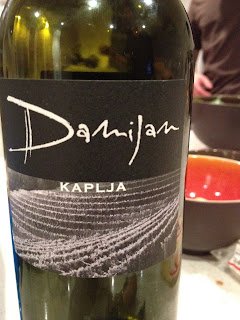
Juice running in contact with the skin in Friuli Italy I DRUNK IT +++++ and I gave it 34/100 while I was smoking a Sant Cristobal cigar from Cuba a the perfect humidity and select temperature... look what a match: SIMPLE I.G.T. from Friuli Venezia Giulia  a simple crazy wine full of mistake, start with the color definitely amber, unfiltered, secondary characteristic on the nose, less fruit and freshness acidity fight with the tannin... lots of shit coming in the glass, sediment, tartaric acidity.. apparently the winemaker forgot to filtered the wine, correct the acidity and didn't use any inverse osmosis filtered. Also he didn't control the temperature... what a lazy wine............ FROM THE WEBSITE OF RAW WINE FAIR In the Gorizia hills of Friuli on the border with Slovenia, winemaker Damijan Podversic makes some of the most personal - and controversial - wines made anywhere. Damijan ferments on the skins in upright wood fermenters using only natural ye...
Image
 Artisan Wines in melbourne... Lately I have been living in Melbourne an amazing town, full of nice small places to eat and drink... I have noticed in the bench of wine bars and the wine list all over the city in the last year there is an attention in "Natural wines" or  in my way  artisan wines.... In all my excursion i had the chance to try lots of nice stuff one of that is a Georgian wine (lately) imported in Australia... Georgia is the country where the wine is born, in-fact the wine born eight thousand years ago, and perhaps the first wine produced was in a region overlooking the Black sea, which the greeks called Colchis what we call today Georgia. Still today the rocky and small republic Caucasian is an extraordinary reserve with dozen of species and  different varieties of wines. Georgia boasts an ancient culture of wine. The wine I tried was from Phesant's Tears a winery led by an american artist John H Wunderman whom fall in love with ...
Image
Il Pettirosso Nebbiolo ARPEPE 1999. Since the Roman times the Valtellina has been the land of very important wine. The wine is obtained by hand selecting the best bunches of grapes and then leaving them to dry on wooden lattices placed inside a dry and well-aired room, the “Fruttaio”, for at least 110 days until the end of January.  During this winter period the climate of the Valtellina does the rest of the work and thus favours the drying and shrinking of the bunches of grapes. At the end of January the grape has lost about 40% of its weight, the fruit has dried and the concentrated juice has developed unusual and very dense aromatic properties. After pressing, a slow fermentation period  follows and at least 24 months ageing and refining, first in wood and then in bottles. Valtellina Sforzato is thus a unique expression of a vine, the Nebbiolo and the area of this fascinating Alpine valley. Valtellina Superiore is always made using Nebbiolo grapes and is divided into ...
Image
Domaine Roulot Mersault 2008, a very close wine trough the nose with lots of oak but the acidity is high and  supports a terrific minerality... i wish to open it in 10 years nose is full of honey and apple with some cardamom and mango, vannilla come along with spiciness. mouthful and complex,,,, elegant with rustic notes gives and hint of the Mersault soil and terroir. Roulot is very an outstanding producers and he married the daughter of De Montille what a joke in Burgundy.... love it... thanks chardonnay
Image
Domaine Leon Barral After founding the domaine in 1993, which he named after his grandfather, Didier Barral decided fairly quickly that biodynamic practices were the best choice for farming his vineyards.    Deep in the heart of the Languedoc, in the Faugères appellation just outside the hamlet of Lenthéric, Domaine Léon Barral is a revolutionary winegrowing. In this Mediterranean climate in the Languedoc where the sun burn the vines this oustanding producer make one of the most exciting wine i had in the last years, his red are completely outstanding recently i had the 2007 Valiniere which is one of his premium wine, 50% whole bunch, wild yeast in contact for 30 days in concrete tanks malolactic fermentation on lees in barriques for 2 years, old oak of-course; 80% Mouvedre and 20% Shiraz. Was really austere and blow me away thanks god to give me the chance to try it. Recently i had is simple Faugeres 2009 Beautifully balanced with ripe berrie...
Image
South Rhone Valley 2011 AOC Cotes du Rhone villages Cairanne Blanc - Domaine Richaud: 29% Clairette, 26% Bourboulenc, 18% Roussanne, 12% Marsanne, 7% Viogner, 8% Grenache Blanc Marcel Richaud has been a pioneer in terms of using a natural way of winemaking in the Cairanne terroir. Member of the "Vins Naturel" in france a terrific association focus in sustainable artisan winemakers: http://www.vinsnaturels.fr This 2011 blanc is a blend of most of the native white grapes varieties in all rhone valley, mostly the time they are the blend of a Chateauneuf du Pape blanc. Cairanne is in the hearth of south Rhone valley between Rasteau and Gigondas just north of Avignone: we had  this wine   a week ago, we decanted it to get all the expression of the blend, the fruit come as early we open, grapefruit, pears aromas. The  beginning  was a bit reductive but slowly open up with a touch of anise,  pepper-berry  and some sandal. deeply length thr...
Image
Montagne de Reims Montagne terroir is rich in chalk a type of  limestone derived from the deposition of tiny life-forms on the bed of the sea which a millennia ago was in this area, thus give a Champagne Ardenne an extraordinary characteristic from his wine especially in Ambonnay, Trepail and Bouzy. Minerality and saltiness drive the wine from that area. Lately have been taste two different R.M. from this part of Champagne from Trepail David Leclapart and from Ambonnay Egly Ouriet. Leclapart a blanc de blanc Apotrè from Trepail David believe in the respect from life so his wine are pure and simply, the use of barrel is primordial, traditional pressing and the adding of sulphur as discreet as possible, indigenous yeast, no insemination with lactic acid bacteria. The racking and bottling are performed according to the rhythms of the moon. The malolactic fermentation is systematic because it allows to stabilize the wines and limit the use of sulfur.  Certified by Ecocer...