Posts

Image
BRUNELLO NOT A BRUNELLO  I never post on my personal diary tasting, a wine which I didn't enjoyed but this time I a need to do this… I was in a rush this afternoon, I stop at the bottle shop to buy a bottle of wine and bring to a friend of mine … So I saw some Barolo was a bit expensive and went to the shell on Tuscany section I saw this Valdicava and I know James Suckling like this one. I never like his way to describe the wine so i never take him serious but this time a said to myself let me give him a chance, INFACT I didn't enjoyed this Brunello di Montalcino completely over extracted dark fruit lots of sweet spice and lots of oak tannin I'll say a wine like Michelle Roland doing in France… So Mr Suckling i was just on impression you don't like real wine or perhaps you really didn't get the means of world terroir… So please stop to infected the web with your recommendation… Because this Brunello doesn't have nothing to do with Sangiovese Grosso and Brun...
Image
CENTRAL OTAGO NEW ZELAND  Central Otago is the coolest wine region and one of the most south southerly wine regions in the world.   It's a continental climate with hot summer and cold winter and hot summer days and cold nights. The local mesoclimates turn out to be suitable for a Pinot Noir. Most winery a less than a decade old with the successful Pinot Noir joined by Pinot gris, Sauvignon blanc, Riesling and Chardonnay. Felton Road single vineyard Calvert in Bannockburn in Central otago 2010 was a bit over extract with pronounced nose of red fruit quite ripe and some beautiful red berries but quite tight wood spice and hint of leather. On the plate quite classic new world Pinot Noir structure long savory with a slightly sweetness mask by the oak. Felton Road  Beginning with meticulous site selection and vineyard design started in 1991, Felton Road's story is one of refusal to compromise. A strict 100% estate policy with fully organic and biodynamic viticult...
Image
CHABLIS The climate in the Chablis region is mostly influenced by the continental climate of the Saône region.  The average annual temperature is around 11°. It is not uncommon for the region to experience minimum evening temperatures of -20° or -25° in January, and evening temperatures below 0° at the end of April and the beginning of May. Favorable daytime temperatures of above 10° begin in mid-April and end around the beginning of October. The town of Chablis lies in the valley of river Serein,  surrounded  by hills, in the best sites it is limestone overlaid with a  layer of Kimmeridgian clay, which is very rich in marine fossils.  Lately I enjoyed this small vigneron Lauren Tribut his Cote de Lechet 2011,was quite interesting. The wine was immediately appealing, crispy and lively, with lovely fruit, lemony aromas, spice apple flowers, smokiness, toasty flavor and direct minerality with shellfish, limestone and button mushroo...
Image
Montlouis Les Choisilles 2009 Grape varieties: Chenin Blanc (Pineau de Loire) Byodinamic system, none of chemicals have been used in the vines, just working on the soil with organic matter and prepared compost. Density 6600 ceps per hectare. Age of the vines 30 to 90 years old. Income are 43 hectoliters for hectare. Soil are silex, clay, limestone and Tuffeau named les Choisiless. Training system Guyot and gobelet. Harvest manual in different times on the field. Today I had this superb wine from Montlouis sur Loire in Touraine district in Loire region. Quite gold in color not really clear and lucid with a complexity viscosity. The nose was youthful but to use an oximoron was developing... note of honey, mushroom, candid citrus character, ripe yellow fruit good balance with a present acidity musk by some residual sugar. Petrol nose, flinty and limestone some undertone of charcoal. Mouthful with deep length and complexity… Need some age to show is best but...
Image
Domaine Vincent Paris 2009 Cornas  It was a great discovery I found this new producer from the slopes of Cornas a really dirty wine which was pleasant on my palate the other night. Cornas is a french wine Apellation d'Origine controlee in the northern region of France south of Lyon. Is one of the smallest appelations in the Rhone and produces only red wine from Syrah grape. Cornas has a continental climate with a south east facing slopes and shielded from wind called les Mistral into spring times and is the first appelation in the Rhone to be harvest. The soil is mainly granite but a different altitude some clay and sandy soil come up, in fact the vineyards are situated beetween 100 meter to 400 meters above sea level. The sunny sector called the "Quartier de Reynard" which has vines at 300 to 400 meter has a granite soil. It is a small appelation of only 90 hectares. Domaine Vincent Paris is a young guys which under the guide of his uncle Robert Michel started t...
Image
Domaine du Coulet Terrasses du Serres 2009 Cornas France.  Matthieu Barret is the man behind this beautiful dirty Syrah from Cornas the bottom of north Rhone Valley. This wine is like a minimal noise composition from Concrete composition in the early 19th century  something like Pierre Schaeffer or Bernard Parmegiani (for the term musique concrete is the essence of breaking down of the structure production of traditional instrument, harmony,  rhythm, and even music theory itself, in attempt to reconstruct music from the bottom up) The nose is dirty, dusty and earthy goudron dark fruit, black pepper, charcoal and tar with intense minerality long finish and dirty on the palate… A beautiful wine not for everyone in the same line of Allemande and Clape.. Love Cornas.    
Image
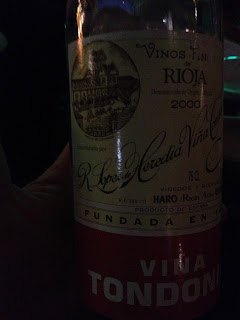
  Viña Tondonia  Viña Tondonia is a beautiful vineyard of over 100 hectares, situated on the right bank of the river Ebro, where the most typical Rioja wines are grown.  Viña Tondonia Rosé Gran Reserva 2000   Last night I had this absolutely gorgeous rose wine from a winery in Rioja. Vineyards here are planted at a range of altitudes from 500 to 800 metres; the soil are a mix of limestone based clay with high proportion of iron. The Cantabrian mountains protect Rioja from the worst of the Atlantic influence thus the continental climate is the key for the long growing season in this region and the altitude mitigate the hot summer that occurs in Spain. The training system are generally bush wine and also help to reheat the sun accumulated during a day in the cool night which in Spain the temperature between day and night can drop even 20°. Planting are dominated by black grapes varieties 75% of Rioja are red wine with 15% rose. The grapes v...
Image
SANGIOVESE... SANGIOVESE AND TOSCANA Sangiovese, the grape of Brunello di Montalcino, Chianti, Carmigniano, Torgiano, and many of the new barrique-aged wines of Toscana, is one of the world noble varieties. Sangiovese is the prominent grape of most red wines of central Italy. It is frequently blended with other grape varieties, but it is the Sangiovese that gives the character, perfume and structure to these wines. This widely grown variety is believed to have originated in Toscana. At various times known as Sangioveto, San gioveto, Sangioghetto and S. Zoveto. This name is according with one theory, derived from Sanguis Jovis "Blood of Jove". The wine tend to be medium in color, not dark red, medium body, dry and firm, with a tannic spine and a floral bouquet, a wine that for the most part, ages moderately well. There are a number of sub varieties of the Sangiovese and no less than fourteen clones. Among the more noted are the Sangiovese piccolo, Sangiovese grossO, know...
Image
Barolo Serralunga Principiano It has been a bit of time since i last posted here. Ive been very busy, with work and two new studies i am undertaking wset level 3 and court of master sommeliers and I'm trying to understand the way the english taste wine and reasonable gives them an identity..with just two books they want to make you understand which is old world, which is new world, which has minerality and which doesn't have minerality and blah blah blah.  So this is what i have been doing in the last couple of months, studying..will i get through? who knows.. In all my blind tasting i got - Malbec from Argentina, a Pinot Noir from Martinborough NZ, a champagne from Reims and in the same time i picked a Chenin Blanc from Loire and it was a Chablis, a Gamay and it was a St Joseph. I confused a Sangiovese for a Shiraz and a Sancerre for a Chardonnay.  I think i am not a great blind taster.. But last night i had this beautiful Barolo from Serralunga by Ferdinando Princ...